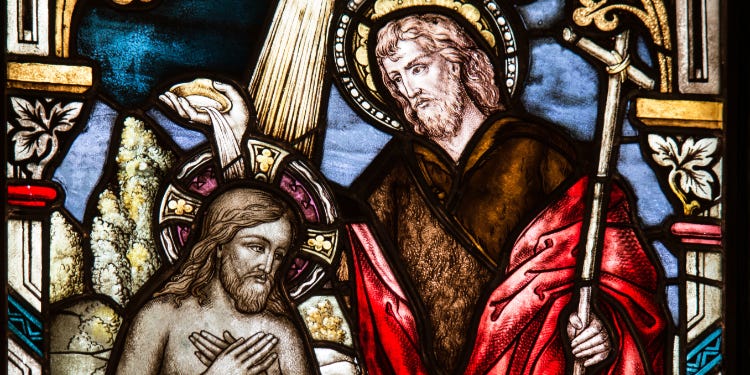
A conversation over a lunch of cheese coneys turned to the topic of Baptism, and—believe it or not—Mike didn’t know that many mainline Protestant denominations teach that Baptism is not necessary for salvation.
By Divine Providence, Joe Heschmeyer’s recent Shameless Popery podcast provided some starting points for this episode’s discussion on the Sacrament of Baptism, who does the “work” of the sacraments, and the theological virtues of faith, hope, and charity.
For Further Information
-
Joe Heschmeyer, Shameless Popery Episode #254 “No, Catholics Aren’t Pharisees”
-
On Baptism by Tertullian (Church Father, early 3rd Century)
-
St. Cyril of Jerusalem, Lecture 3—On Baptism (Church Father, 4th Century)
For Fun
Many Protestants cite the “good thief”—St. Dismas—as not being baptized in water, but still meriting heaven through his faith. A dogma of the Catholic Church teaches that one can also be baptized through blood (martyrdom) or through desire, and it would seem that St. Dismas would fit the bill for “baptism by desire” as in “he desired to be with Christ, but would die before a baptism is possible.” But there’s an old legend that is worth noting that implies a water baptism…
In Venerable Archbishop Fulton Sheen’s The Seven Last Words, the second chapter is entitled “This day thou shalt be with Me in Paradise,” and it shares this:
There is a legend to the effect that when, to escape the wrath of Herod, Saint Joseph and the Blessed Virgin were fleeing into Egypt with the Divine Child, they stopped at a desert inn. The Blessed Mother asked the lady of the inn for water in which to bathe the Babe. The lady then asked if she might not bathe her own child, who was suffering with leprosy, in the same waters in which the Divine Child had been immersed. Immediately upon touching those waters baptized with the Divine Presence, the child became whole. Her child advanced in age and grew to be a thief. He is Dismas, now hanging on the Cross by the side of Christ!
Whether the memory of the story his mother told him now came back to the thief and made him look kindly on Christ, we know not. It might have been that this first meeting with the Savior was on the day when his heart was filled with compunction on hearing the story of a certain man that went down from Jerusalem to Jericho and fell among robbers. Perhaps, too, his first intimation that he suffering with the Redeemer came to him as he turned his torture head and read an inscription which bore His name, “Jesus”; His city, “Nazareth”; His crime, “King of the Jews.”
At any rate, enough dry fuel of the right kind gathered on the altar of his soul, and now a spark from the central Cross falls upon it, creating in it a glorious illumination of faith. He sees a Cross and adores a throne; he sees a condemned Man, and invokes a King: “Lord, remember me when Thou shalt come into Thy Kingdom.”
…
It was the thief’s last prayer, perhaps also his first. He knocked once, sought once, asked once, dared everything and found everything. When our spirits stand with John on Patmos, we can see the white-stoled army in Heaven riding after the conquering Christ; when we stand with Luke on Calvary, we see the one who rode first in that procession. Christ, Who was poor, died rich. His hands were nailed to a Cross and yet He unlocked the keys of Paradise and won a soul. His escort into Heaven was a thief. May we not say that the thief died a thief, for he stole Paradise?
The story can also be found in The Life of Mary As Seen by The Mystics, by Raphael Brown.