“Well, if it really becomes Jesus’s body and blood, it would taste different.”
My non-Catholic friend of over thirty years just made the statement that many Protestants make when denying the Real Presence of Jesus Christ in the Eucharist. This was after an extended back-and-forth on the topic, which involved all of the classic elements of Catholic versus Protestant debate on the topic. You know, it was the typical dissection of John 6 with the “is it literal or figurative language,” the insistence that a Protestant’s “Lord’s supper” was effectively the same as the Catholic Liturgy of the Eucharist and consecration of the host, mention of Eucharistic miracles, and all the rest.
In vain, I labored to use all of the Catholic apologetics arguments I had come across over the years. There was no lightbulb, no “ah ha” moment of breakthrough, and no, “I never thought of it that way before” admission.
Another stalemate. Nothing new to see here. Move along, folks, move along.
What I failed to realize at the time is that the problem lies simply in two different yet interconnected things, the first of which is philosophy.
With philosophy we get precise language to talk about and describe things. Doctors have “doctor lingo” and engineers have “engineer lingo” and software programmers have “programmer lingo.” And like any other specialized area of interest, philosophers have “philosopher lingo.” Since by and large we don’t teach the basic principles of philosophy as part of primary education anymore,* our use of philosopher lingo to talk about the Real Presence isn’t necessarily the best approach with about 99% of the population. Heck, the word “transubstatiation” itself is philosopher lingo that has to be explained, and even then it’s accurate to say that a fair number of people who try to explain it don’t fully grasp it themselves but rather they repeat what they heard or read.
Why is that? Well, it’s because if you know the terms and you start talking about “substance” and “accidents” you’re asking the other person to swim in waters where—more likely than not—they don’t know how to swim. It’s not their fault; they haven’t had lessons in philosophical swimming. And if you don’t know the difference between “substance” and “accidents” then it’s really really hard to explain transubstantiation.
Bottom line? While most people can sort of grasp what “substance” is—and I do mean “sort of” because most people’s understanding is not really the way philosophers mean it—past that point, it gets murky. You see, when you move on from “substance” and start talking about “accidents,” the next thing people think of is car wrecks, not philosophy. At that point you lose them. They look at you like you’re from Mars. Sorry, does not compute.
There is a contributing factor at play here, something that I covered in more detail in my book Rebellion but it’s important to mention it here to give context.
Back in 1285, a Franciscan friar named William of Ockham was responsible for some rather unorthodox teachings, and among these was one I’d like to draw attention to today. He argued that the nature of anything of this world could be ascertained only by what we can perceive with our senses.** From here, things started falling like dominoes.
Ockhamism was highly influential in how Martin Luther developed his errant theology. (Luther himself proudly announced that he was “an Ockhamist.”) Luther, of course, ushered in the Protestant revolt which denied the Real Presence. This eventually led to the Enlightenment and the “Age of Reason.” And when the Industrial Revolution came about, it also brought with it a massive change in public schooling where bit by bit philosophy stopped being taught at the insistance of factory owners who were by and large Protestants.*** What these factory owners didn’t want were thinkers; they needed laborers, human cogs in their factory machines.
And what do we get after 150 years of denying the majority of the population an education in philosophy?
Among other things, you get the inability of the majority of the population to have a true philosophical discourse about things like transubstantiation.
So let’s fix that right now.
Long after the conversation with my friend, it dawned on me one fine morning while praying the Rosary (a daily practice I highly recommend) that covid gave us the perfect way to explain what happens during transubstantiation, using an analogy and no big philosophy words. Ready?
Did you ever get covid? You know how when you have covid you can’t smell or taste? So imagine that you open a brand new bottle of iced tea and pour a little into a glass to take a pill for your headache. You take a sip and taste nothing. You smell it and smell nothing. Uh oh. You go to the hall closet, pull out a rapid covid test, and after taking it… positive. You have covid. Probably picked it up from your spouse who also has covid. You go back to your glass and drink it to take your pills. About fifteen minutes later you feel the effects of alcohol. What the heck? You look at the bottle. It’s regular old iced tea, not “hard” iced tea. It was exactly the same as when you left it: brown liquid in a glass.
Then you talk to your spouse. Turns out, they fixed themselves a glass of whiskey, sat their glass right next to yours, and they grabbed the wrong glass. Since they also have covid, they couldn’t tell the difference either. And while you were drinking their whiskey, they were wondering why they didn’t feel the effects of alcohol.
Your senses were only able to tell you that it was brown (sight) and wet (touch) but since you didn’t have the senses to determine taste or smell, the iced tea and drink of whiskey appeared to be the same, even though they were substantially different.****
The reason we can’t detect the change in the host from ordinary bread into the body, blood, soul, and divinity of our Lord Jesus Christ is simply a matter of the fact that we are limited to our five senses. If we had a sixth sense that could detect the presence of the Divine, then it would be easy. But we don’t. We in a permanent state of “spiritual covid.”
This is captured beautifully in the Eucharistic hymn Tantum Ergo. Though typically sung on its own and thought of as its own hymn, it is actually the last two stanzas of the hymn Pange Lingua, which was composed by St. Thomas Aquinas in 1264 for the feast of Corpus Christi… the Body of Christ… and it is the hymn sung during Eucharistic benediction. The Latin reads, in part:
Praestet fides supplementum
Sensuum defectui
which translates to:
Faith for all defects supplying
Where the feeble senses fail
Where the feeble senses fail indeed!
Now let us look at the preceding line of that hymn, which gives us the second interconnected thing that works together with philosophy to give us our understanding of the Real Presence made possible by transubstantiation: faith.
Now, I don’t want to accuse those Christians who don’t believe in the Real Presence of not having faith. Painting with a rather broad brush, it’s safe to say that if you ask them if God created everything out of nothing, they would say “yes.” They have no proof since they weren’t around at the beginning to experience creation with their five senses, but they have faith. Similarly, it’s rather safe to say that if you asked them if Jesus Christ was a real person who walked the earth, they would say yes. None of them were alive 2000 years ago, but as a matter of faith, they believe it. There are other things they almost certainly take on faith as well: that Jesus Christ is the Son of God, that through his death we are saved, and that he will come again in glory. They believe all these things as a matter of faith, and God bless them for the faith they have.
But when confronted with the Real Presence, to say “If I can’t experience it with my senses, then I don’t believe it” is—by definition—a lack of faith.
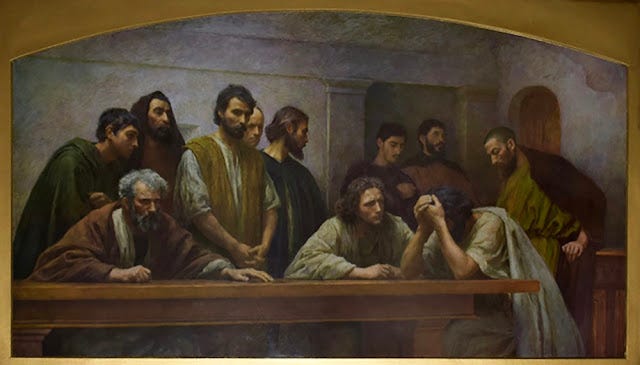
Let’s look at St. Thomas in the Gospel of John, chapter 20:24-25:
Now Thomas, one of the twelve, called the Twin, was not with them when Jesus came. So the other disciples told him, “We have seen the Lord.” But he said to them, “Unless I see in his hands the print of the nails, and place my finger in the mark of the nails, and place my hand in his side, I will not believe.” (RSVCE)
How is this any different than saying, “Unless I see the Eucharist changed from bread into flesh and taste blood instead of wheat, I will not believe”?
It’s not.
We see that when Thomas is with the others when Jesus comes the second time, Jesus gently rebukes him in John 20:29 when he says, “Have you believed because you have seen me? Blessed are those who have not seen and yet believe.” (RSVCE)
Belief in the Real Presence isn’t a matter of science. It isn’t a matter of senses. It is a matter of faith.
Jesus said that he will remain with us, and there he is in the Eucharist, keeping his promise: “behold I am with you all days, even to the consummation of the world.” (Matthew 28:20 DRA)
So it is that when I hear people deny the Real Presence, I am reminded of the words of our Lord in Mark 9:19 when the father of the boy troubled since birth brought the boy to Jesus: “O faithless generation, how long am I to be with you? How long am I to bear with you?”
The gift of the Eucharist is the gift of Jesus Christ being truly present with us, always, out of his love for us. He is there to nourish our souls. He is there to comfort us and guide us and to be really and truly present and never leave us alone. He is there because he said he would be.
When our feeble senses fail, may we like the boy’s father, pray, “I believe; help my unbelief!”
So that with unbridled faith, we, like St. Thomas, can look upon the Eucharist and exclaim, “My Lord and my God!”
* We have stopped teaching these philosophical principles to our own detriment. Prior to the changes in public education that coincided with the industrial revolution, the basics of philosophy were something that was taught as part of a classical liberal arts education. Ultimately I think it will be the ultimate cause of our societal downfall unless we change course.
** A synod of bishops found William of Ockham’s teachings to be highly unorthodox, and he was summoned by a papal court in 1324 to defend himself against charges of heresy.
*** There’s no hard data on this, but here’s the common sense approach: The majority of Americans were Protestant at the time, and the vast majority of those who had the money as well as the social and political connections to establish factories were Protestant. A fair, common-sense estimate would be somewhere between 80-90% of all factories were owned by Protestants.
**** I realize that at some point, all metaphors break down. This is the case here, as some will be quick to point out that iced tea is mostly water and even barrel proof whiskey is still a certain percentage of water. Others would point out that there are other characteristics of whiskey—such as the fumes from the alcohol—which would be immediately noticeable. My point is still the same: if you gave the two glasses to someone and said “what’s in each glass?” the answer wouldn’t be a breakdown of ingredients by percentages but instead the answers would be “this one is iced tea, that one is whiskey” which is my point.